Age-Appropriate Chores for Kids, and How Many to Give Them
Your 11 year old can run a phone, a games console and three group chats, yet the dishwasher still empties itself by magic. Or your 5 year old wants to help and you are not sure what to hand over. Either way, the question is the same: which jobs fit this age, and how many is fair?
 Choru is an iPhone appPoint your iPhone camera at the code to install it.
or text me the link
The short answer
There is no official number of chores for any age. What the American Academy of Pediatrics (AAP) offers instead is a list of jobs that fit each stage, and one rule about pace: introduce one new task at a time, because a long list can be overwhelming. So the right number is "what your child already does well, plus one".
For an 11 year old, the AAP's list is longer than many parents expect. On top of everything younger kids do, it includes cleaning the kitchen, changing bedsheets, unloading the dishwasher, doing and folding laundry, scrubbing toilets and cleaning the bathroom, washing the car, cooking a simple meal with supervision, and watching younger siblings while an adult is at home. A 5 year old can make their bed, set and clear the table, put toys away and fill the pet's food dish.
A workable starting point, and our suggestion rather than a research figure: one or two small daily jobs plus one or two bigger weekly ones, then add a job after a good week. The table below sends you to each age band.
| Age | Typical jobs | See |
|---|---|---|
| Toddlers and preschoolers | Helping you, putting things back | Under 5 |
| 5 to 7 | Bed, table, toys, pet's dish, sorting laundry | 5 to 7 |
| 8 to 10 | Vacuuming, own laundry, groceries, snacks | 8 to 10 |
| 11 to 12 | Kitchen, bathroom, full laundry, a simple meal | 11 to 12 |
| Teens | Shared spaces, the car, shopping, siblings | Teens |
What age is appropriate for chores? Earlier than you might think
The AAP's age list starts at 5, but the wish to help starts well before that. In a study by Felix Warneken and Michael Tomasello at the Max Planck Institute, 18 month old children helped an adult who had dropped a clothes peg out of reach, and in 84 percent of cases they helped within the first 10 seconds, before the adult had even looked at them. They helped when the adult seemed to be struggling, not when he had thrown the object on purpose. The AAP puts it simply: young children are naturally eager helpers.
At this age a chore is less a job than a shared activity. Carrying their cup to the counter, putting a book back on the shelf or dropping socks into the laundry basket next to you counts. The aim is to keep that willingness alive, which is why the AAP advises praising the effort, not the result, and not expecting perfection.
Chores for ages 5 to 7
The AAP's list for this age: make their own bed, set and clear the table, weed and rake leaves, make and pack school lunches, dust, put toys away, tidy bookshelves, put dirty clothes in the hamper, fill the pet's food dish, empty wastebaskets, sweep floors, sort laundry, bring in the mail, water flowers and wash plastic dishes in the sink.
That is a menu, not a schedule. A chore chart for a 5 year old might hold just three things: make the bed, put toys away before dinner, fill the cat's bowl. Our tip: pick jobs with a clear finish, so the child can see they are done. "Put the books on the shelf" ends; "tidy your room" has no edge.
We would also keep rewards for a 4 or 5 year old close: a reward that takes weeks to earn is a long way from today's tidying. There is more on picking rewards in how to make a chore chart for kids that lasts.
Chores for ages 8 to 10
Everything above, plus, per the AAP: vacuum, help make dinner, make their own snacks, take a pet for a walk, put away their own laundry and put away groceries.
Our suggestion for this age: try handing a 7 or 8 year old one job completely, such as emptying the bins on bin day, rather than having them help with five. Owning it means they also remember it, without being asked. Pick a job that happens on a fixed day, so the rhythm itself does part of the reminding.
How many chores should an 11 year old have?
The AAP's list for 11 and 12 year olds adds the jobs that keep a house running: clean the kitchen, change the bedsheets, unload the dishwasher, do and fold laundry, scrub toilets and clean the bathroom, wash the car, cook a simple meal with supervision, and watch younger siblings with an adult at home.
Should 11 year olds do chores? The AAP's answer is that children need obligations and duties within the family so they learn to accept responsibility, and that a busy schedule is not a reason to drop them. It also warns against overloading, and asks parents to think about each child's temperament and work style.
In practice, an 11 year old could carry a mix like this:
- Daily: unload the dishwasher, wipe the kitchen counters after dinner.
- Weekly: clean the bathroom sink and toilet, change their own bedsheets.
- Their own laundry: wash, dry, fold and put away, on a set day.
- Now and then: cook one simple meal with you, like pasta or eggs.
That is five or six jobs, but only two of them happen on most days. Count chores by the time they take, not by how many there are: cleaning a bathroom is not the same size as feeding a fish. The same thinking works between grown-ups, as how to split chores fairly with your partner explains.
Chores for teens
In its guide to household chores for adolescents, the AAP suggests vacuuming shared spaces, washing and vacuuming the car (especially if they have car privileges), doing the grocery shopping once they can drive, and helping with younger siblings. It is blunt about schedules: sports practice does not make anyone too busy to take out the garbage without a reminder, and a part-time job after 16 is not a reason to stop helping at home. Its argument is that a teen who can run a smartphone can learn a washing machine, an oven and a dishwasher.
How to give kids more chores without a fight
The AAP's practical advice comes down to five habits:
- One new task at a time. A long list can overwhelm a child who has not had chores before. Our rule of thumb: add the next job once the current ones run without reminders.
- Spell out what done means. Spell out each task clearly, and make sure your child knows what you expect each day and each week.
- Same time every day. The AAP suggests doing chores at the same time each day, so they become part of the routine like meals and bedtime.
- Regular family meetings. Review how it is going, ask for the child's ideas and update the plan together.
- Encourage more than you scold. The AAP says honest praise can be the most effective way to motivate a child, and that scolding is not an effective way to build responsibility. Skipped chores can still have consequences, such as losing a privilege.
A chore chart or checklist helps make it a routine, the AAP says. Any list works if the child can see it without asking you. For more on building the whole family's list, see how to manage household chores.
Do chores actually help kids?
There is some evidence they may. A 2022 study in the Australian Occupational Therapy Journal surveyed the parents of 207 children aged 5 to 13. After allowing for age, gender and disability, children who did more self-care chores (like making themselves a meal) and family-care chores (like making someone else a meal) had better working memory and inhibition, two of the skills used to plan, follow instructions and hold back an impulse. Pet-care chores showed no such link.
Read that carefully. It was a one-time survey based on parent reports, so it cannot show which way the effect runs: the authors point out that children with stronger skills may simply be more willing to do chores, or be given more of them. It is a reason to keep going, not proof that emptying the dishwasher builds a better brain.
Chore rewards and earning money
The AAP suggests honest praise first, and says tangible rewards like allowances and stickers tied to completed chores are also worth considering. A split that suits many families, and again our suggestion: the basic jobs are part of living in the house, and extra jobs earn something. That keeps "I don't need the money this week" from switching the dishwasher off.
Our suggestion: let points buy something the child chose, rather than just piling up. The details, including keeping the first reward within reach, are in the kids' chore chart guide.
Setting it up on your family's iPhones
The built-in Reminders app can hold a simple version. Make a list, share it from the Share button, and once it is shared you can assign each reminder to a person. Apple notes that invitees have to accept before they can add or complete items, and that alerts you set are not shared with them. What Reminders does not have is anything for kids: no points, no rewards and no way to check a job before it counts.
Choru is a family chore app built for that part. Here is how the age plan above fits into it:
- Start a family in Settings, then Family. Your child joins on their own iPhone by scanning the family's code, and turns on I'm a kid. A family can have up to five people.
- Add each chore and pick its Repeat: daily, specific days, weekly, monthly, or a custom rhythm. Put it on your child's list with the For row.
- Give each chore 1, 2 or 3 coins. The bigger jobs from the age lists, like cleaning the bathroom, can pay 3.
- In the Kids tab, add rewards for each kid and set their prices.
- To check work before the coins land, turn on Need a grown-up's OK for that kid in Settings, under Family. Their ticks then wait for a grown-up to approve them.
Starting a family and marking a kid need Choru's trial or the unlock, as there is no free version.
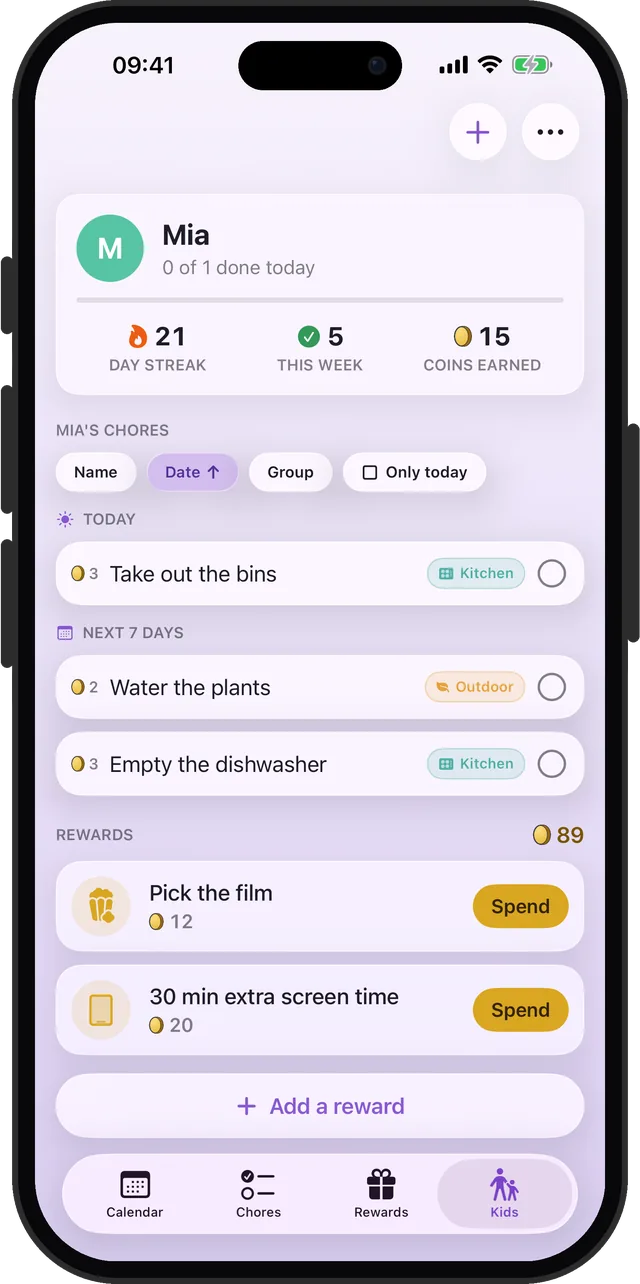
A kid's phone locks itself to their own chores and rewards, so nobody re-prices their own jobs, and a grown-up gets past it with the parent PIN. A streak pays bonus coins at 3, 7, 14 and 30 days, then every 30 days after that. When it is time to add the next job, as in the one-at-a-time rule, it is one more chore on their list. To get everyone onto the same list first, see how to share a chore list with your family on iPhone.
Frequently asked questions
How many chores should an 11 year old have?
There is no official number. The American Academy of Pediatrics lists jobs like cleaning the kitchen, changing bedsheets, doing laundry and cleaning the bathroom for ages 11 and 12, and advises adding one new task at a time so the list never overwhelms. A daily job or two plus a few weekly ones is a reasonable place to start.
What age is appropriate for chores?
Children can start helping as toddlers. In a Max Planck Institute study, 18 month olds helped an adult pick up a dropped object, usually within 10 seconds. The AAP's age list of chores starts at 5, with jobs like making the bed, setting the table and putting toys away.
What chores can a 5 year old do?
The AAP lists making their own bed, setting and clearing the table, putting toys away, putting dirty clothes in the hamper, filling the pet's food dish, emptying wastebaskets, sorting laundry and watering flowers. Pick two or three with a clear finish, and praise the effort rather than the result.
What chores can a 7 year old do?
A 7 year old can do everything on the AAP's list for ages 5 to 7, such as sweeping, dusting and packing their school lunch, and is close to the 8 to 10 list, which adds vacuuming, putting away their own laundry and putting away groceries. Our suggestion: let them own one job end to end, including remembering it.
Should kids get paid for chores?
The AAP says honest praise can be the most effective motivator, and that tangible rewards like allowances and stickers tied to chores are also worth considering. One approach is to treat everyday jobs as part of family life and let extra jobs earn money or points.
Do chores help children's development?
A 2022 survey of the parents of 207 children aged 5 to 13 found that kids who did more self-care and family-care chores had better working memory and inhibition. It was a one-time, parent-reported survey, so it cannot show that chores cause the difference.
Sources
- HealthyChildren.org (American Academy of Pediatrics): Chores and Responsibility, updated 2024
- HealthyChildren.org (American Academy of Pediatrics): Household Chores for Adolescents, updated 2024
- Max Planck Society: Baby's helping hands (on Warneken and Tomasello, Science, 2006)
- Tepper, Howell and Bennett (2022), Executive functions and household chores, Australian Occupational Therapy Journal (PMC full text)
- Apple Support: Share and assign reminders on your iPhone or iPad