How to Manage Household Chores Without a Weekend Marathon
Saturday morning, and the whole week's mess is waiting: laundry on the chair, pans in the sink, a bathroom nobody has looked at properly in a while. You clean until mid-afternoon, and by Wednesday it is back. A calmer house has more to do with the list than with effort.
 Choru is an iPhone appPoint your iPhone camera at the code to install it.
or text me the link
The short answer
Household chores get manageable when they stop living in your head. Write down every job once, give each one its own rhythm (daily, weekly, monthly or rarer), give each one a single owner, and keep the list somewhere that tells you what is due today. Then do a little most days instead of everything on one day, and decide in advance what happens when you miss one.
Your iPhone can already carry part of this. The built-in Reminders app can repeat a reminder, share a list with people, and assign a reminder to someone on a shared list. For a short list, that is enough. What it does not do is add up who did what, or send one summary of the day instead of an alert for every dated reminder. A chore app such as Choru is built around exactly those two things. The steps below work with paper, Reminders or an app; the tool matters less than the system.
Step 1: Write down every chore, including the invisible ones
Start with one sitting and one list. Walk the house room by room: kitchen, bathroom, bedrooms, living room, laundry, outside. Write every job you can see, then the ones you cannot: descaling the kettle, cleaning the dishwasher filter, washing the duvet, booking the boiler service.
Then add the thinking. The sociologist Allison Daminger interviewed 70 people in 35 couples and split the mental side of housework into four parts: anticipating a need, identifying options, deciding, and monitoring that it got done. In her study, women were far more likely than men to anticipate and monitor. Those two parts are exactly what a written list with dates takes over. If the list knows the oven is due in March, nobody has to carry that in their head.
Step 2: Give every chore its own rhythm
A list without dates turns into a guilt list. The fix is to give each job its own clock, based on how fast it gets bad, not on when you happen to have time. A starting point:
| Rhythm | Typical jobs | See |
|---|---|---|
| Daily | Dishes, wipe the counters, a 10-minute tidy | Step 4 |
| Every few days | Laundry, empty the kitchen bin | Step 4 |
| Weekly | Toilet, shower, floors, bed sheets, bins out | Step 5 |
| Monthly or rarer | Fridge, oven, windows, gutters | Step 6 |
Treat it as a first draft. A house with a dog needs the floors more often; a flat with no garden drops a whole row. The rare jobs are the ones that slip, because nothing in daily life reminds you of them. The deep cleaning schedule guide has a full list of the monthly, quarterly and yearly jobs and how to spread them so they never all land on one weekend.
Step 3: Give every chore one owner
"Someone should clean the bathroom" means nobody will. Each chore gets one name next to it. Owning a chore means doing it and also remembering it, so nobody else has to ask. That second half is what stops the reminding and the resentment that comes with it.
Not sure what a child can own yet? Age-appropriate chores for kids lists the jobs that suit a 5, 8 or 11 year old and how many to start with.
How you split the jobs is a separate question. One for one rarely feels fair, because ten minutes with the bins is not an hour of ironing. Weigh by time and by who minds which job least; the full method is in how to split chores fairly with your partner. Kids can own chores too, from feeding a pet to emptying the dishwasher, and a chart with rewards they can spend helps it stick (see how to make a chore chart for kids).
Some jobs can stay in a shared pile for whoever has a free moment. That works as long as everyone can see the pile.
Step 4: Tie the daily ones to something you already do
Daily chores should run on autopilot, and the research on habits says how to get there. Decide in advance exactly when and where a chore happens, as an if-then plan: "When I finish dinner, I wipe the counters." "When the kettle is on in the morning, I empty the dishwasher." Psychologists call these implementation intentions. A review of 94 independent tests by Peter Gollwitzer and Paschal Sheeran found they had a medium-to-large effect on reaching goals.
Expect it to take a while before a chore feels automatic. In a study by Phillippa Lally and colleagues at University College London, people repeating a new daily behaviour took 66 days on average to reach peak automaticity, with a range from 18 days to a predicted 254. Two details from that study are worth keeping:
- One missed day did not undo the habit. A single slip had little effect on progress, so a skipped Tuesday is not a reason to start again from zero.
- Many misses did add up. Repeated gaps, even spread out, lowered how automatic the habit eventually became. Consistency matters more than perfection.
Step 5: Do a little most days, in short timed bursts
Housework takes real time. In the US government's American Time Use Survey for 2025, 81 percent of people did some household activity on an average day, spending about 2 hours on it. On days they did, women averaged 2.8 hours and men 2.1. Pile all of that onto Saturday and it eats the day.
Short bursts spread across the week are easier to start and easier to keep. Pick one or two of the weekly jobs per evening, set a timer for 10 or 15 minutes, and stop when it rings. A timer turns "clean the bathroom" from an open-ended job into a small, finite one, and you will often find a job you dreaded fits inside it.
Any timer works. Choru has one built in: tap the timer button on the Calendar tab to start a timed tidy of 1 to 30 minutes. It is just a timer, on purpose: when it ends, you tick off what you actually got done.
Step 6: Decide what happens when you miss one
You will miss chores. A cold, a late shift or a visit is enough. The question is what your system does next.
- On paper or a whiteboard, a missed job is simply gone until someone notices.
- In Reminders, an overdue reminder stays in the Today list until you tick it, but every dated reminder also sends its own alert, so a long list means a lot of alerts.
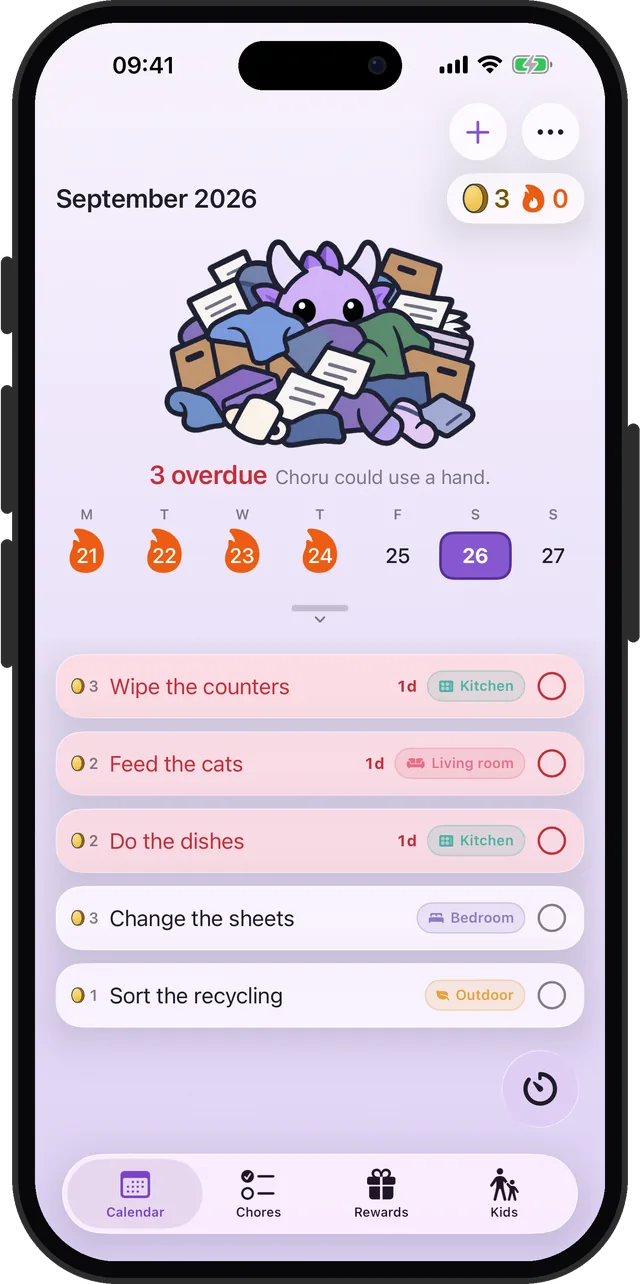
- In a chore app, the missed job should come forward to today as one entry that says how many days late it is, without multiplying into one entry per missed day.
That last behaviour is what Choru does: a missed chore carries over to today as one row, marked with how late it is. Ticking it settles it, and the chore goes back to its normal rhythm.
The other half of planning for misses is being honest about capacity. If the same chore is overdue every week, the rhythm is wrong, not the person. Move it from weekly to every two weeks, or hand it to someone else, and see if it holds.
Step 7: Put the system on your iPhone
With the built-in Reminders app
- Open Reminders and make a new list called Chores.
- Add each chore, then open its details, turn on a date and tap Repeat to set its rhythm.
- To share it, tap the list, tap the Share button, and send the invitation by Messages or Mail. Invitees can add, delete and complete items once they accept.
- Once the list is shared, tap a reminder, tap the Assignment button, choose the person and tap Done.
Apple notes that alerts you set on a shared reminder are not shared with others, so each person sets their own. For a couple with a short list, this works well. There is a longer look at the trade-offs in can you use the iPhone Reminders app for chores.
With Choru
- Add a chore with the + button and pick its Repeat: daily, specific days, weekly, monthly, quarterly, or Custom for every few days, weeks, months or years.
- Tag it with a room, like Kitchen or Bathroom, so the Chores tab can group the list by room.
- For jobs with no fixed date, add an anytime task instead. Tick it when you get to it, and it can come back a month, three months, six months or a year later.
- In Settings, turn on Daily summary: one notification a day, at a time you pick, naming what is due. Not one alert per chore.
- To share the list, open Settings, then Family, and start a family. Each person scans the code with Choru on their own iPhone. Then use each chore's For row to say whose it is.
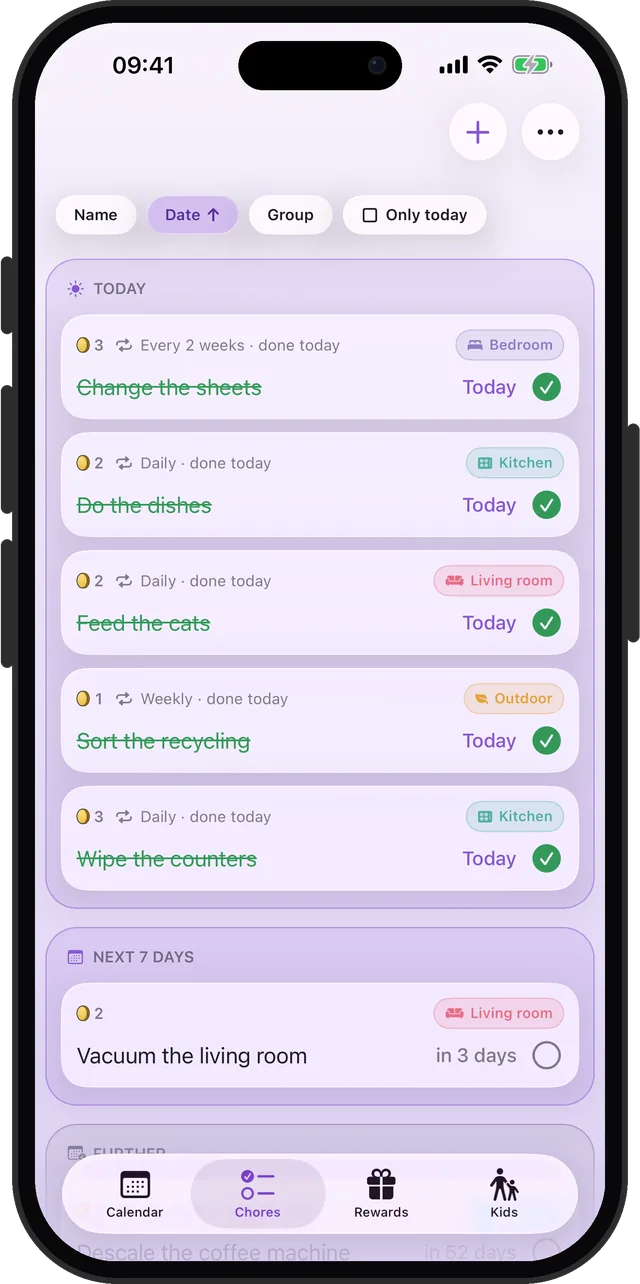
Once a family is shared, Choru's Stats show who did what this week. That turns "I do everything" into a number you can look at together, which is the whole point of Step 3. More on getting everyone onto one list is in how to share a chore list with your family on iPhone.
Bonus: chores count as movement
The World Health Organization counts movement done as part of domestic activities as physical activity, and recommends adults get at least 150 minutes of moderate-intensity activity a week. The 2024 Adult Compendium of Physical Activities lists how hard common chores are in METs, where 1 MET is a standard resting rate:
| Chore | METs |
|---|---|
| Scrubbing floors or the bathtub on hands and knees, vigorous | 6.5 |
| Carrying groceries upstairs | 5.3 |
| Mopping, moderate effort | 3.5 |
| Vacuuming, moderate effort | 3.0 |
| Making the bed, changing linens | 3.0 |
| Dusting or polishing furniture | 2.5 |
| Washing dishes, standing | 2.0 |
So if you were wondering which household chores burn the most calories, the scrubbing and carrying jobs top the list, and washing up sits near the bottom. The Compendium itself notes that real resting rates vary with age, sex, size and body composition, so read these as a comparison between chores, not a calorie count for you.
Frequently asked questions
How do you manage household chores when you work full time?
Spread the work across the week instead of saving it for the weekend. Give each chore its own rhythm, tie the daily ones to something you already do, like finishing dinner, and do one or two weekly jobs per evening in a 10 to 15 minute burst. A list that tells you what is due today means you never have to plan it from scratch.
How can I make household chores easier?
Make them smaller and more predictable. Use short timed bursts instead of open-ended cleaning sessions, keep the rare jobs on a schedule so they never become big jobs, and give each chore one owner so nobody has to keep reminding anyone. Research on if-then plans and habits suggests deciding in advance when a chore happens is what makes it stick.
Is there a household chores app for iPhone?
Yes. The built-in Reminders app can repeat reminders, share a list and assign items, which works for a short list. Choru is a chore app for iPhone that adds one daily summary notification instead of an alert per chore, missed chores carried over to today with how many days late they are, and a shared family list with weekly stats per person.
How do you divide household chores with a spouse?
List every chore together, including the rare and invisible ones, then split by time and by who minds which job least rather than one for one. Each chore gets one owner who both does it and remembers it. Our guide on splitting chores fairly with your partner walks through it step by step.
What if I miss a day of chores?
Do not start over. In a study of habit formation at University College London, missing a single day had little effect on how well the habit formed, though many misses did add up. Pick the missed chore up today, and if the same one keeps slipping, change its rhythm or its owner.
Which household chores burn the most calories?
The 2024 Adult Compendium of Physical Activities rates vigorous floor or bathtub scrubbing on hands and knees at 6.5 METs and carrying groceries upstairs at 5.3, against 3.0 for vacuuming and 2.0 for washing dishes. Higher METs mean more energy used per minute. The values are averages; your own burn depends on your age, sex and size.
Sources
- U.S. Bureau of Labor Statistics: American Time Use Survey, 2025 results
- JSTOR Daily: The gendered labor of noticing and anticipating (on Daminger, American Sociological Review, 2019)
- Gollwitzer and Sheeran (2006), Implementation intentions and goal achievement: a meta-analysis (University of Konstanz repository)
- Lally et al. (2010), How are habits formed: modelling habit formation in the real world, European Journal of Social Psychology
- British Psychological Society Research Digest: How long to form a habit (on Lally et al., 2010)
- 2024 Adult Compendium of Physical Activities: Home activities
- Herrmann et al. (2024), 2024 Adult Compendium of Physical Activities, Journal of Sport and Health Science
- World Health Organization: Physical activity fact sheet
- Apple Support: Share and assign reminders on your iPhone or iPad
- Apple Support: Use Reminders on your iPhone or iPad
- Apple iPhone User Guide: Add details in Reminders on iPhone
- Apple iPhone User Guide: Use Smart Lists in Reminders on iPhone