Chores for Kids to Earn Money: What to Pay For, and How
Your kid wants something that costs money, and you would quite like the car washed. Paying for chores sounds like the obvious deal, until you wonder whether you will now be paying for the bed to get made, too.
 Choru is an iPhone appPoint your iPhone camera at the code to install it.
or text me the link
The short answer: pay for the extras, not the basics
Good chores for kids to earn money are the jobs on top of everyday family life: washing the car, weeding a flower bed, clearing out the garage, sorting the recycling for a month. The basics, like making their bed, clearing their plate and putting their laundry away, work better unpaid, as part of living in the house. The U.S. Consumer Financial Protection Bureau (CFPB) suggests exactly that conversation for school-age kids: talk about what counts as "extra" in your family and how to earn it.
Why split it that way? Research suggests money is a weak lever for getting everyday chores done. In a study of 30 middle-class working families in Los Angeles, the authors concluded that an allowance was not an effective motivator for children's household work (see what the research says). Money is better at something else: giving a child real practice at earning, saving and choosing what to spend on.
On iPhone, the built-in tools cover parts of this. A shared list in Reminders can hold the jobs. In the U.S., Apple Cash Family can send a child scheduled payments from Wallet. Nothing built in connects the two, so nothing records which job earned what. That is the gap a chore app like Choru fills (see Step 5).
| Question | Section |
|---|---|
| Which chores to pay for | Step 1 |
| Paid jobs by age | Step 2 |
| How much to pay | Step 3 |
| Rules that keep it fair | Step 4 |
| Tracking it on iPhone | Step 5 |
Step 1: Decide which chores are paid and which are not
Write down every job your kid does now or could do. Then sort the list into two columns.
- Family jobs, unpaid. Anything that looks after themselves or their own mess: making the bed, putting toys and clothes away, carrying their plate to the sink, packing their school bag. Everyone in the house does these, and nobody gets paid for them, grown-ups included.
- Extra jobs, paid. Work you would otherwise do yourself, pay someone for, or let slide: washing the car, raking leaves, washing windows, deep cleaning the fridge shelves, helping clear out a cupboard, a weekly bathroom clean for an older child.
A useful test, and our suggestion rather than a rule: if the job would still need doing when the child is away for a week, and someone else would have to pick it up, it can be a paid job. If it only exists because the child lives there, it is a family job.
This split also protects you from the obvious problem. If every job is paid, a child who does not want money this week has no reason to do any of them. With the basics outside the deal, "I don't need the money" only switches off the extras.
Step 2: Pick paid jobs that fit their age
A paid job should be one the child can finish alone, with a clear end, so both of you agree when it is done. Some ideas, as a starting point:
- Around 5 to 7: matching all the socks from the clean washing, wiping the low kitchen cupboard doors, watering every plant in the house, sorting the recycling.
- Around 8 to 10: vacuuming the car, weeding one bed, washing the outside bins, polishing everyone's shoes.
- Around 11 and up: washing the car, cleaning the bathroom, mowing the lawn with you nearby, cleaning the oven racks, cooking a simple family meal.
For the everyday jobs each age can handle, based on the American Academy of Pediatrics' list, see age-appropriate chores for kids. Many of the less frequent jobs that make good paid work are in the deep cleaning schedule: the oven, the fridge shelves, the windows.
Step 3: Set a price you can keep paying
There is no official rate for kids' chores. What matters more than the number is that you can keep paying it for months without wincing. One way to set it, which is our suggestion:
- Start from a weekly budget. Decide what you are happy to pay out in a typical week if every extra job gets done.
- Price by time and effort, not by job. A job that takes an hour should pay more than one that takes ten minutes.
- Put the first goal within reach. If the thing your child wants takes three months of work, the deal may not last that long. Pick a first job and a first goal that can meet within a couple of weeks.
- Add a saving nudge if you like. The CFPB suggests that parents of kids aged 6 to 12 can match savings, for example five, ten or 25 cents for every dollar the child saves.
Rewards do not have to be cash. Thirty minutes of extra screen time, picking the film, or a day out can be priced the same way, and for a young child they may mean more than coins in a jar. The kids' chore chart guide covers picking rewards together.
What the research says about paying kids for chores
Money does not reliably get the chores done
Klein, Graesch and Izquierdo followed 30 middle-class, dual-earner families in Los Angeles, combining interviews with children and observations of what they actually did at home. Children did fewer tasks than they reported in interviews, and the authors concluded that allowance is not an effective motivator. They also found that inconsistent and unclear expectations from parents lowered children's participation. It is a small, observational study, so it cannot prove cause, but it points at clear expectations as the stronger lever.
Expected rewards can crowd out the wish to help
A 1999 meta-analysis in Psychological Bulletin pooled 128 experiments on rewards and intrinsic motivation, meaning whether people keep doing something by choice once the reward stops. Tangible rewards that people expected undermined that motivation, and tangible rewards tended to be more harmful for children than for college students. Positive feedback did the opposite and raised both free-choice behavior and self-reported interest. That fits the American Academy of Pediatrics' advice for chores: honest praise can be the most effective way to motivate a child, and praise the effort rather than the outcome. It is one more reason to leave the everyday jobs unpaid and keep praise in the mix for the paid ones too.
Money is good practice
The case for paid chores is about money skills, not motivation. A study of Dutch households by Bucciol and Veronesi found that parental teaching to save raised the likelihood of saving as an adult by 16% and the amount saved by about 30%, and that the strongest approach combined pocket money, some control over how it is used, and advice about saving and budgeting. A University of Arizona and Brigham Young University study in the Journal of Family Issues argued that hands-on practice with money is a third way kids learn about it, beside watching their parents and being taught directly. The CFPB says the most important part of an allowance for a child's development is talking with you about their plans for the money.
So the money does its best work after the chore: deciding what to save for, waiting, and talking about whether it was worth it.
Step 4: Rules that keep paid chores fair
- Define done before the job starts. "Wash the car" can mean a rinse or an hour with a sponge. Say which, out loud, before you agree a price. That is the unclear expectation the Los Angeles study warned about.
- Check it before it pays. A quick look before the money lands keeps the deal honest, and it is a natural moment for the praise the research favors.
- Pay on time. A promise that drifts teaches the wrong lesson about earning. If you pay on a set day, keep to it.
- Family jobs come first. A simple rule: the paid list opens once the family jobs for the day are done.
- Talk about the money. Ask what they plan to buy, and later how it went. The CFPB's parent handout for middle childhood says that if you give an allowance, talk with your child often about how they plan to use it, how they actually used it, and what they learned.
Step 5: Track paid chores on your family's iPhones
With the built-in apps
You can put the paid jobs in a shared list in the Reminders app and tick them off together. To hand over real money in the U.S., Apple Cash Family lets the family organizer set up Apple Cash for a child under 18, then schedule payments from Wallet. Per Apple Support, as of the current iOS 27 releases:
- On the organizer's iPhone, open Settings, tap your name, then Family Sharing, then the child, then Apple Cash, and follow the steps.
- To pay on a schedule, open Wallet and tap your Apple Cash card.
- Tap the More button, then Apple Cash Family, then the child's name.
- Under Recurring Payments, tap Set up, then choose the amount, the start date and how often it is sent.
What neither app does is link the job to the pay. A recurring payment goes out whether or not the car got washed, and a ticked reminder earns nothing. For a split between paid and unpaid jobs, you end up keeping the tally in your head.
With Choru
Choru is a family chore app that keeps that tally. Every chore pays 1 to 3 coins when it is ticked, and you write the rewards and set their prices in coins. A reward can be anything you type, including money you will hand over, like "$5 to spend". Coins are a tally inside the app, not money: Choru does not pay anyone, so the cash still comes from you, or from Apple Cash.
- Start a family in Settings, then Family. Your child joins on their own iPhone by scanning the family's code. A family can have up to five people.
- In Settings, Family, mark them in the Kids row. A kid's phone then shows only their own chores and rewards.
- Add each paid job and put it on your child's list with the For row. Give the bigger jobs 3 coins and the quick ones 1.
- In the Kids tab, add a reward for them, for example "$5 to spend", and type its price. The line under the price estimates how often it could be earned at the current pace, such as "about every 8 days", so you can tune the price before you save it.
- To check work before it pays, tick your child in the Need a grown-up's OK row. Their ticks then wait under To check off in the Kids tab, and the coins land when you tap Approve. Not yet removes the tick, so the job is owed again.
- When they spend coins on the reward, it shows as claimed. Hand over the money, then tap Mark used. The reward's history keeps the date it was claimed and used.
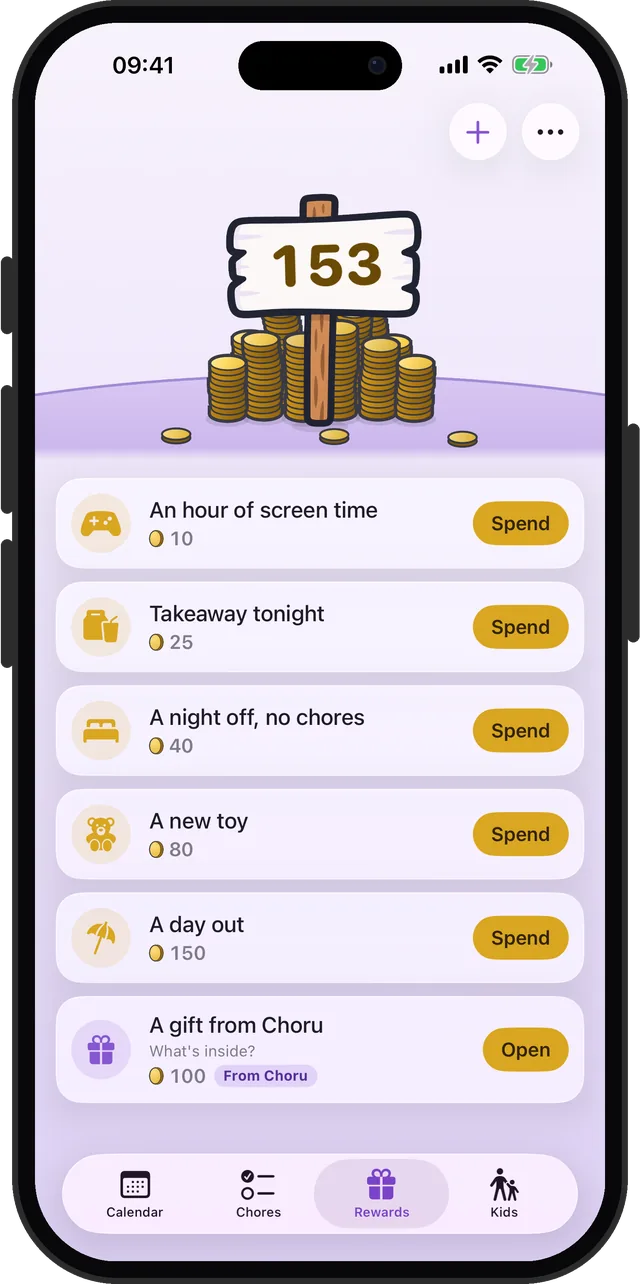
A kid cannot add or re-price rewards on their own phone, and only a grown-up can mark a reward used. To keep family jobs unpaid in spirit, you can still give them 1 coin each and make the money rewards cost enough that the extra jobs do most of the earning. A streak also pays bonus coins at 3, 7, 14 and 30 days, then every 30 days, which rewards turning up every day rather than one big job. Choru is paid, with a yearly plan that starts with a free trial or a one-time lifetime unlock, and one plan covers the family.
Getting everyone onto one list first? See how to share a chore list with your family on iPhone.
When the deal stops working
- They stop caring about the money. That is fine for the extras. The family jobs carry on, because they were never paid. Wait for the next thing they want.
- The quality slips. Go back to Step 4 and say again what done means. Check before paying until it holds.
- Everything becomes a negotiation. "Will you pay me to clear my plate?" No: that is on the family list. Keeping the two lists written down ends most of those talks.
- They save nothing. Try the CFPB's matching idea from Step 3, and talk about a goal before payday, not after.
Frequently asked questions
What chores can kids do to earn money?
Good paid chores are the extras on top of everyday family life: washing the car, weeding, washing windows, cleaning the bathroom for an older child, or helping clear out a cupboard. Keep jobs that look after their own things, like making their bed, unpaid. Pick paid jobs with a clear end, so you both agree when they are done.
Should kids get paid for chores?
Paying for extra jobs can give kids real practice with earning and saving, and the American Academy of Pediatrics lists allowances tied to chores as one reward worth considering. A study of 30 Los Angeles families found an allowance was not an effective motivator for household work, though. One approach is to keep everyday jobs unpaid and pay only for extras.
How much should I pay my child for chores?
There is no official rate. Start from what you can pay in a typical week, price each job by the time it takes, and make the first goal reachable within a couple of weeks. The CFPB also suggests matching what a child saves, for example 10 or 25 cents per dollar.
Is it bad to pay kids for chores?
Not on its own, but a 1999 meta-analysis of 128 experiments found that expected tangible rewards tended to undermine motivation, more so for children, while positive feedback raised it. That is a reason to keep praise in the mix and not to pay for every job in the house.
Can I pay my kid's allowance on iPhone?
In the U.S., yes, with Apple Cash Family: the family organizer sets up Apple Cash for a child under 18, then sets up Recurring Payments in Wallet. It sends the money but does not know which chores were done. A chore app like Choru can keep the tally, with a reward such as "$5 to spend" that you then pay out.
Sources
- Consumer Financial Protection Bureau: Money as You Grow, Explore earning (school-age children to preteens)
- Consumer Financial Protection Bureau: Money as You Grow, for your child during middle childhood (parent handout)
- Consumer Financial Protection Bureau: Toddlers to teens, how to kick-start your child's saving habits
- Klein, Graesch and Izquierdo (2009), Children and Chores: A Mixed-Methods Study of Children's Household Work in Los Angeles Families, Anthropology of Work Review (Crossref record with abstract)
- Deci, Koestner and Ryan (1999), A meta-analytic review of experiments examining the effects of extrinsic rewards on intrinsic motivation, Psychological Bulletin (Europe PMC record)
- Bucciol and Veronesi (2014), Teaching children to save: What is the best strategy for lifetime savings?, Journal of Economic Psychology (abstract)
- University of Arizona: Parents, to prepare kids financially, give them practice with money (on LeBaron et al., Journal of Family Issues, 2018)
- HealthyChildren.org (American Academy of Pediatrics): Chores and Responsibility, updated 2024
- Apple Support: Set up and use Apple Cash Family (published September 14, 2026)
- Apple Support: Apple security releases (current iOS version, 27.2.1 on November 9, 2026)